Showing posts with label lines. Show all posts

November 26, 2014

Chapter 12 Lines


Chapter 12:  Normal at Last: Heaven

"All their life in this world... had only been the cover and title page: now at last they were beginning Chapter One of the Great Story which no one on earth has read: which goes on for ever: in which every chapter is better than the one before." ~C.S. Lewis, The Last Battle

p 225  No word in the English language moves the human heart in quite the same way as the word 'home'. Jesus recognizes that the deepest yearnings of the human heart - to belong, to be safe, to be prized - are really a yearning for heaven.  When we get there, it will not seem strange to us.  When we get there, we will say, "This is home."

My notes:  This chapter focused extensively on what the bible actually says about heaven  - most specifically from Revelation and John's vision of the throne room, Jesus, etc.   It also talks a bit about the fact that many of us have a seriously distorted view of heaven based on opinions and fantasy instead of what Scripture teaches.

This book was challenging in many ways and provided a lot of food for thought.  As a person who struggles seriously with what I term ' an over-developed sense of justice' coupled with a very low threshold for lack of common sense, the commands in scripture to love & forgive are some of the hardest ones for me to obey cheerfully, and completely.  I have been greatly encouraged by parts of this book as well though because it has afforded me the chance to see areas where God is growing me and changing my heart.  These things are always exciting to me.

I would absolutely recommend reading this book thoughtfully and honestly looking at how it speaks to your individual situation in conjunction with God's heart for forgiveness.

Blessings on the journey~

November 24, 2014

Chapter 11 Lines


Chapter 11: The Secret of a Loving Heart: Gratitude

p 205 The ability to assign value is one of the rarest and most precious gifts in the world.

p 213  The one who is forgiven much loves much.  The one who is forgiven little loves little.

p 213 (Here we are at the end of the retelling paraphrase of the story in Luke 7:36-50)  
There is a great sin defiling this room. It is the sin of lips that won't kiss, knees that won'd bed, eyes that will not weep, hands that will not serve, perfume that will never leave the jar.  It is the sin of a heart that will not break, a life that will not change, a soul that will not love.  The greatest command is the command to love.  The greatest sin is refusal to obey the greatest command.

p 214  We complicate our faith and lives in many ways, but at the core, our purpose is simple: we are called to love.

p 217 The ability to assign value is one of the rarest and greatest gifts in the world.
So value what God values. There is an ancient story about a poor traveler who is amazed by the welcome he receives at a monastery. He is served a lavish meal, escorted to their finest room, and given a new set of clothes to replace the rags he arrived in.  Before leaving, he commented to the abbot on how well he was treated.  Yes, the abbot said, we always treat our guests as if they are angels - just to be on the safe side.

November 21, 2014

Chapter 10 Lines


***my note: I found this chapter challenging because my personal experience has been that the church at large - (not all - but many) - seem to be far from Jesus' heart of community and love in how they operate on a usual basis.  

Chapter 10: Breaking down barriers: Inclusion

p 186 There are few joys in life like being wanted, chosen, embraced.  There are few pains like being excluded, rejected, left out.  At the core of Christian community is the choice, in the words of Miroslav Volf's great book* on the subject, between exclusion and embrace.

p 195 Jesus is the greatest bridger the world has ever seen.  When the church understood his heart, it became a community like nothing else the world has ever seen.

p 201  ... ultimately, the choice everyone faces is the choice between hope and despair.  Jesus says, "Choose hope."

p 202-203  The most desirable society in the universe turns out also to be the humblest and the least exclusive.  The Father, Son, and Holy Spirit are determined that the circle of love they share from all eternity should be ceaselessly, shamelessly inclusive.  It is not full yet.  They invite all who will to join them. No one is left out except those who refuse to enter.


*Miroslav Volf, Exclusion and Embrace. Nashville: Abingdon Press, 1996

October 20, 2014

Chapter 9 Lines


Chapter 9  The Gift Nobody Wants: Confrontation

p 169 "Nothing can be more cruel than the leniency which abandons others to their sin.  Nothing can be more compassionate than the severe reprimand which calls another Christian in one's community back from the path of sin." ~Dietrich Bonhoeffer

p 169  This is a foundational paradox about the porcupines in our world; we want to know the truth about ourselves, and we want very much NOT to know the truth about ourselves. We both seek and resist awareness about the reality of who we are.

p 171  We need Truth-Tellers because our capacity to live in denial is astounding.

p 171  Many of us have never invited someone else to be a Truth-Teller in our lives for the same reason we don't get on a scale: we are afraid of what we might find out.

p 172  "One who because of sensitivity and vanity rejects the serious words of another CHristian cannot speak the truth in humility to others. Such a person is afraid of being rejected and feeling hurt by another's words.  Sensitive, irritable people will always become flatterers, and very soon they will come to despise and slander other Christians in their community... When another Christian falls into obvious sin, an admonition is imperative, because God's Word demands it.  The practice of discipline in the community of faith begins with friends who are close to one another. Words of admonition and reproach must be risked." ~ Dietrich Bonhoeffer

p 173  We need others to help us live up to our best intentions and deepest values.

p 179  There is a very important theological distinction between being a prophet and being a jerk.  What burns deeply in the heart of a true prophet is not just anger but love.

p 179  Accountability is a tool and a gift we give to one another to try and realize the growth we could never know all by ourselves.

p 180  Let us consider the cost of truth-telling and why it happens so rarely in our world.  the answer, simply, is fear.  It takes enormous courage to be a Truth-Teller.  If we speak painful truth to someone, things get messy.

p 180  Scott Peck says that most of the time we live in what he calls 'pseudo-community'.  It's hallmark is the avoidance of conflict  Pseudo community is agreeable and polite and gentle and stagnant - and ultimately - fatal.

p 181  To go beyond pseudo-community, Peck says, we have to be will to enter into chaos.  Chaos happens when someone is willing to speak risky truth.  Chaos is always unpleasant.

p 181  People who love authentic community always prefer the pain of temporary chaos to the peace of permanent superficiality.

p 183  When we have nobody to answer to - no one holding us accountable for living up to the values we most deeply hold - we become very vulnerable.
   *vulnerable to sin and sliding away from God (my note)

October 14, 2014

Chapter 8 Lines


Chapter 8  Spiritual Surgery: Forgiveness

p 151  Community always involves a kind of promise, whether or not it ever gets stated out loud.  It is a promise of commitment and loyalty.  When that promise gets broken, so does someone's heart.

p 152  Forgiveness is the only force strong enough to heal relationships damaged by hatred and betrayal.

p 156   But forgiveness does not come cheap.

p 157   Some things forgiveness is NOT:
             1. Forgiving is not excusing - forgiving doesn't mean tolerating or pretending.  When an action is excusable - it doesn't require forgiveness.
             2. Forgiving is not forgetting - forgiving is what's required precisely when we can't forget.
             3. Forgiving is not the same thing as reconciling.

p 158   Forgiveness takes place in the heart of one human being. It can be granted even if the other person does not ask for it or deserve it.  Reconciliation requires the rebuilding of trust, and that means good faith on the part of both parties.

p 158   Forgiveness begins when we give up the quest to get even. This is difficult because getting even is the natural obsession of the wounded soul.

p 159  Of course, letting go of vengeance doesn't mean letting go of justice. Justice must still be honored.

p 159  The next stage of forgiveness involves a new way of seeing and feeling. When we forgive, we begin to see more clearly. We don't ignore the hurts, but we see beyond them. We rediscover the humanity of the one who hurt us.

p 160  The third stage of forgiving, the one that shows you have begun to make some real progress, is when you find yourself wishing the other person well. When you want good things for someone who hurt you badly, you can pretty much know that the Great Forgiver has been at work in your heart.

p 160  God commands us to forgive because it is the best way to live. God commands forgiving because to refuse to forgive means I allow the one who hurt me to keep me chained in a prison of bitterness and resentment.  No human beings are more miserable than the unforgiving.

p 164  If you don't forgive - if you let pride, resentment, stubbornness, and defensiveness stand in your way - you become a hard and bitter person.  You carry a burden that will crush the humanity out of your spirit.  You will grow a little colder every day.  You will die.

p 165  True forgiveness is never cheap.  Hurt is deep; hurt is unfair. ... only one thing costs more than forgiving someone - NOT forgiving them. Non-forgiveness costs your heart.

p 166  Don't forgive, and your anger will become your burden. Don't forgive, and bit by bit all the joy will be choked out of you. Don't forgive, and you will be unable to trust anybody, ever again. Don't forgive, and the bitterness will crowd the compassion out of your heart slowly, utterly, forever.


October 9, 2014

Chapter 7 Lines


Chapter 7  Community is worth fighting for: Conflict

"Communities need tensions if they are to grow and deepen. Tensions come from conflicts...  A tension or difficulty can signal the approach of a new grace of God. But it has to be looked at wisely and humanly. " ~Jean Vanier

p 127  There is no greater challenge in building community than to master the art of handling anger and conflict.  ..we must consider how important this topic is in God's eyes. It is both remarkable and appalling that by and large in churches today, we are not scandalized by broken relationships and chronic enmity between people.  We are not scandalized by lack of love.
But Jesus is.

p 128  We have been invited into the Fellowship of the Trinity. When we violate oneness, when we contribute to relational brokenness, it doesn't just affect us and the other person.  We are contributing to the destruction of that which is most prized by God and was purchased by him at greatest cost - the oneness of the Trinitarian community.

p 130  Matthew 18:15 may be the single most violated of all the instructions Jesus gave the human race.

p 131  To be alive means to be in conflict.  It's part of the dance of the porcupines. People may not be normal, but conflict surely is - at least in our world.

p 132  Interestingly, while Jesus tells his hearers they should take the responsibility to set things right if the other person has sinned, in another setting (Matt 5:23-24) he tells his hearers to take the first step if they are the ones in the wrong.  Jesus puts the burden on you in both cases.
Why?  Because people who value community are people who own responsibility to deal with relational breakdowns.

p 132  "Go" Jesus says. Take action. Don't let resentment fester.

p 133  Anger exists to tell you something is wrong and to move you to action.  Anger exists so you will be motivated to make it go away.  However, remember Proverbs 14:17 and Ephesians 4:26.

p 134-135 Causes of our anger? Fear? Frustration? Hurt? What outcome do we want? to win? to hurt someone?

p 136  Sometimes you should become angry. However even then you still must decide how to express your anger.

p 138 Conflict is inevitable. Resentment is optional.

p 139  The need for sensitivity is one of the most important - and often misunderstood - aspects of healthy anger management.

p 141 The simplest guideline is to approach the other people the way you would want to be approached in their place.

p 142  We must speak truth in love - clearly.

p 143  The goal in conflict resolution is not to win or score points - it's reconciliation.  Your aim should be to restore the relationship.  Reconciliation is rarely simple and almost never quick.

p 144  Direct confrontation doesn't always do good.  Sometimes it escalates the conflict. Sometimes it leads to violence. Confrontation can do tremendous damage. Then we need a miracle.  God created one.  It's called forgiveness - that's in the next chapter.


September 26, 2014

Chapter 6 - Lines


Chapter 6 The Art of Reading People: Empathy

p 108  Researcher Daniel Stern calls the ability to read and respond well to someone's heart attunement. Relationally intelligent people are geniuses at it.

p 108 One dangerous aspect of this skill is that, generally, people who don't read others well aren't aware that they don't.  It is like being emotionally tone-deaf.

p 109 The good news is that relational intelligence can be learned. Develop this skill, get it right, an you will have opportunities to influence, comfort, challenge, and love people on a regular basis.

p 112  The New Testament writer James says, in one of the most often violated commands in all scripture, that everyone should be "quick to listen, slow to speak." Listening, writes Daniel Goleman, is the single most important relational skill a person can develop.

p 113  It is no accident that we speak of paying attention to people, attention is the most valuable currency we have.

p 113 ...one hunger is universal. You have never met a person who doesn't long for more joy. WH Auden wrote, "Among those whom I like or admire, I can find no common denominator, but among those whom I love, I can: all of them make me laugh."

p 115  A friend of mine says that one of the hardest things in the world is to be right and not hurt anybody with it.   (OOOOOOHHHH)

p 116  It's an amazing truth: Being fully right rarely brings as much life to people as simply being human.
People are hungry for joy bringers.

p 117  If you are part of a family, friendship, club, organization, department, small group, or church, you are part of what Daniel Goleman calls an "emotional economy".  Every single interaction we have with another person involves not simply exchanging information or performing tasks but also influencing each other's moods and attitudes.  The emotional economy is "the sum total of exchanges of feeling among us."

p 121  Deep in the heart of everyone you work with, play with, live with, is a sign, if only you will take the time to read it: "Inspire me. Challenge me to grow and then celebrate with me when I stretch. Help me shoulder whatever burden life throws my way."

p 123-124  You are a guardian of the human spirit.  You have the power to manipulate and coerce if you want to. You can avoid and ignore if you choose. But you can also ennoble and inspire. You can lift up and appeal to all that is good and honorable and holy. You can remind fallible and finite people around you that they hold their lives and calling as a sacred trust, that their best efforts matter, that their worst failures will one day be redeemed.
This is all because of the Crucified One who shouldered the burden of the whole human race, who rose again, will come back one day to honor all that is good and set right all that has gone wrong.


September 24, 2014

Chapter 5 - Lines


Chapter 5  Put Down Your Stones: Acceptance

p 89  You and I were made to be in the life-saving business. Mostly the life lines we have to offer are words.  Every word we speak has the power either to give a little life to people or to destroy a little bit of their spirit and vitality.

p 94  We are most scandalized by sins of the flesh.  Jesus was most scandalized by sins of the spirit.

p 99  Condemnation and judgement have become so deeply rooted in the human spirit that most of us can't imagine having to function without them.

p 101  People need more than toleration.  Bertrand Russell wrote, "A sense of duty is useful in work but offensive in personal relationships. People wish to be liked, not to be endured with patient resignation."   (OUCH!)

p 101 Acceptance is an act of the heart. To accept someone is to affirm to them that you think it's a very good thing they are alive.

p 102  This is very important: acceptance is NOT the same thing as tolerating any behavior one chooses to indulge in. (emphasis mine) Accepting another human being does not mean we refuse to confront or challenge that in them which could harm others and damage their soul.
Failure to confront, to speak the truth in love, can ultimately be as fatal to community as judgementalism.


August 21, 2014

Chapter 3 - Lines


Chapter 3: The Fellowship of the Mat: True Friendship

p 46  Psychologist Alan McGinnis notes that rule number one for entering into deep friendships sounds deceptively simple: Assign top priority to your relationships.

p 46  If you think you can fit deep community into the cracks of an overloaded schedule - think again. Wise people do not try to microwave friendship, parenting, or marriage.

p 48 Jean Vanier writes, There is no ideal community. Community is made up of people with all their richness, but also with their weakness and poverty, of people who accept and forgive each other, who are vulnerable with each other. Humility and trust are more at the foundation of community than perfection.

p 52 There is a world of difference between being friendly to someone because they're useful to you and being someone's friend.

p 55  Do you have any idea what the faith of one person can do for a friend?

p 57  Paul Waddell writes, "In spiritual friendship, the principal good is a mutual love for Christ and a desire to grow together in Christ. This is what distinguishes spiritual friendships from other relationships."

p 59  Dallas Willard ~ "To understand Jesus' teachings, we must realize that deep in our orientations of our spirit we cannot have one posture toward God and a different one toward other people."

p 61  There is no gift like the gift of community.

July 18, 2014

Chapter 2 - Lines

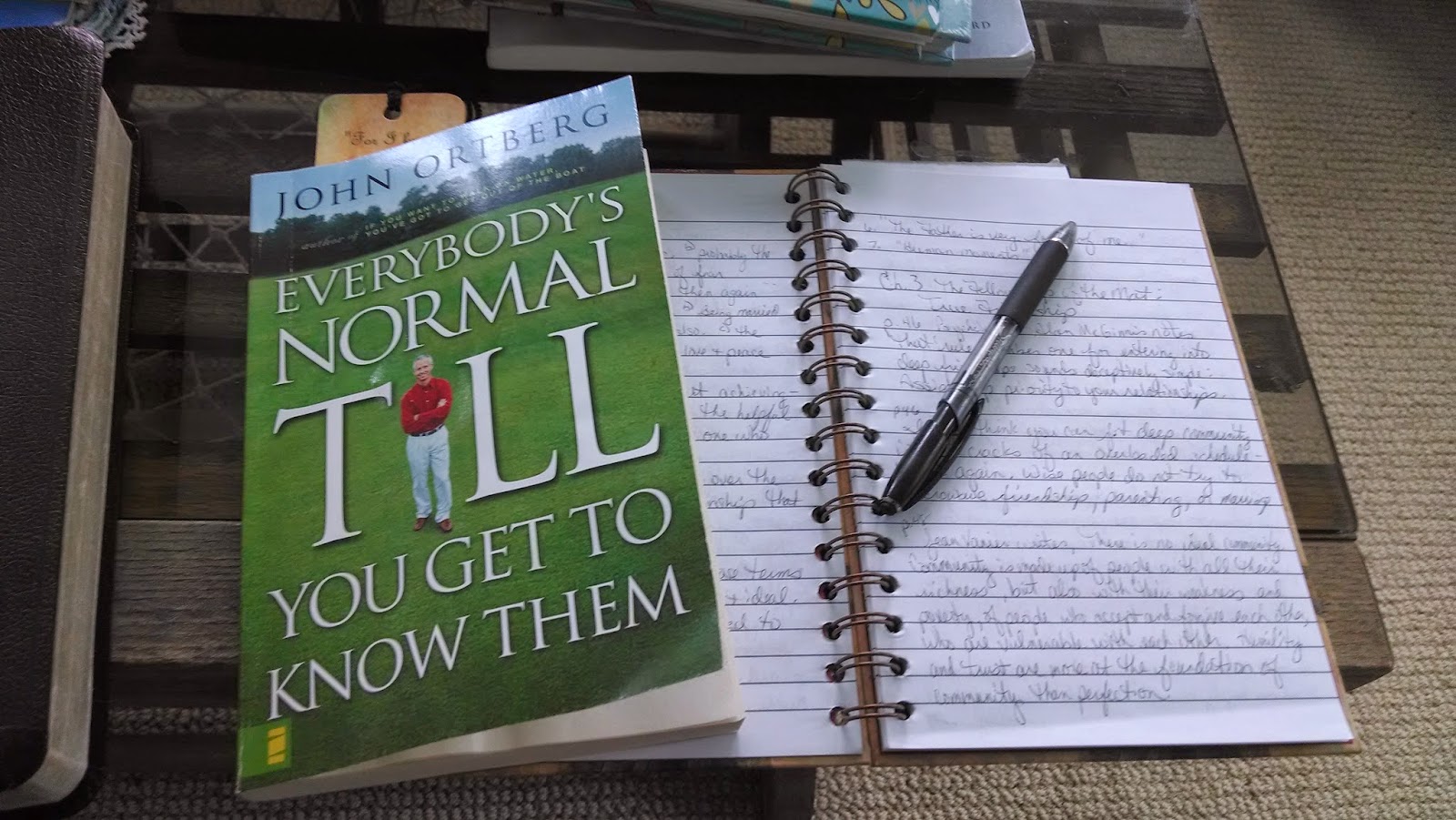
All page references are from the above pictured book

Ch. 2  The Wonder of Oneness

p. 29 ... people will admit to being lonely in anonymous polls, but when asked to give their names they will say they are independent and self-sufficient.

Loneliness, said Mother Teresa, is the leprosy of modern society.  And no one wants anybody to know they're a leper.

p. 30  Albert Schweitzer said, "We are all so much together, but we are dying of loneliness."

[Edward} Hallowell points out that our society is increasingly devoted to, obsessed with, and enslaved by achieving, and increasingly bankrupt and impoverished when it comes to connecting.

p. 31  No matter how little money we have, no matter what rung we occupy on anybody's corporate ladder of success, in the end what everybody discovers is that what matters is other people.  Human beings who give themselves to relational greatness - who have friends they laugh with, cry with, learn with, fight with, dance with, live and love and grow old and die with - these are the human beings who lead magnificent lives.

We were made to know oneness. That is why loneliness is so painful.

p. 33 [Robert Putnam] and a team of researchers documented that for twenty-five years American society has experienced a steady decline of what sociologists call 'social capital' - a sense of connectedness and community.

p. 34 ... the idea of the Trinity turns out to be vitally important because it tells us that God himself has been experiencing community throughout eternity.   **I find this idea fascinating!

p. 37  Dallas Willard states, "Ultimately, every human circle is doomed to dissolution if it is not caught up in the life of the only genuinely self-sufficient circle of sufficiency, that of the Father, Son, and Holy Spirit. For that circle is the only one that is truly and totally self-sufficient.  And all the broken circles must ultimately find their healing there, if anywhere."

p. 38 The Trinity is "a self-sufficing community of unspeakably magnificent personal beings of boundless love, knowledge, and power," as Dallas Willard puts it.

p. 40 What is most amazing is that God invites us into the Fellowship of the Trinity.

p. 41 When Jesus prays for us (John 17:20-21) to be invited into the divine circle, it is not a casual request. There is an enormous price to be paid for our admittance. The Son will go to the cross. The Father - who had known nothing from all eternity but the perfect intimacy with His Son - will now see his Beloved suffer the anguish and alienation of sin. The Spirit will come to earth and allow himself to be quenched and grieved by human beings.  At enormous cost to every member of the Trinity, you and I have been welcomed to the eternal circle, to be held in the heart of the Father, Son, Spirit.
*** I had never considered it quite this way before... what sacrifice!  How can I not have ever realized the enormity of what transpired - not just at the cross, but from the Father, and the continuing work of the Holy Spirit?  Staggering...

July 16, 2014

Beginning More Lines


I am one of those readers who makes notes and copies down lines when I read something that I'm trying to study.  I find it helpful to use the old fashioned method of paper & pen (or pencil) to write things out long-hand to drive home points that touch me as I read.  This series of posts will be a collection of the notes, quotes, lines, etc. from my reading of the book by John Ortberg, Everybody's Normal Till You Get to Know Them.  This is just one of several books I have read, am reading and have stacked up to read  - all relating to living life as part of God's community of believers and the world at large.  This is a journey of discovery and change and is, quite honestly, hard & painful at times.

So ... here goes.

Part 1: "Normal: There's No Such Thing, Dear"
Ch. 1: The Porcupine's Dilemma
"To make a start where we are, we must recognize that our world is not normal, but only usual at present." ~Dallas Willard

p.14  When you deal with human beings, you have com to the 'as-is' corner of the universe. We are tempted to live under the illusion that somewhere out there are people who are normal. When we enter relationships with the illusion that people are normal, we resist the truth that they are not. One of the great marks of maturity is to accept the fact that everybody comes 'as-is'. 

p. 15  Of course, the most painful part of this is realizing that I am in the 'as-is' department as well.  ... the writers of Scripture insist that no is "totally normal" - at least not as God defines normal. (see Isaiah 53:6 and Romans 3:23

p. 16 Because we know in our hearts that this is not the way we're supposed to be, we try to hide our weirdness.  Everyone of us pretends to be healthier and kinder than we really are; we all engage in what might be called "depravity management."

p. 18  And yet... the yearning to attach and connect, to love and be loved, is the fiercest longing of the soul.

p. 19  "The natural condition of life for human beings is reciprocal rootedness in others." ~Dallas Willard

p. 20 "Whoever cannot stand being in community should beware of being alone." ~Dietrich Bonhoeffer

p. 25  This is a book about how imperfect people like you and me can pursue community with other imperfect people.

So it begins... and I have the strong sense that I'm going to learn a lot.  There are personal reflection questions at the end of each chapter, which I'm attempting to answer for myself in my journal, but I'm not willing to share here on the blog.  Some things are private and the internet is most definitely not.

Blessings on the journey~

June 4, 2014

New Book Study...more lines!


Quick back story...
We moved in part because we craved small town living... and hoped to discover the lost art of community.   We also left our church after 10 years in large part due to the serious lack of genuine community & depth of relationship.  In recent months God has been speaking into our lives loudly on this topic.
I read a great book called

Then we did a study at a local church called "Christian" by Andy Stanley - which was truly excellent. (The link takes you to the YouTube playlist of all the sessions)

This week I began a new book study and have begun again making lots of notes of the lines that speak to me most loudly.  So those I will share in coming posts along with anything of note that I am learning and changing in my own life.
This is the book:

Blessings on the journey~

September 16, 2013

Lines (15) The final chapter


Continuing notes from "A Long Obedience in the Same Direction"
***we made it!***

Chapter 16   Blessing   Psalm 134

pg 184  "In Psalm 120, the first of the Psalms of Ascents, we saw the theme of repentance developed.  The word in Hebrew is teshubah, a turning away from the world and a turning toward God; the initial move in a life-goal set on God.  It was addressed to the person at the crossroads, inviting each of us to make the decision to set out on the way of faith.  Each of the psalms that followed has described a part of what takes place along this pilgrim way among the people who have turned to God and follow him in Christ.  We have discovered in these psalms beautiful lines, piercing insights, dazzling truths, stimulating words.  We have found that the world in which these psalms are sung is a world of adventure and challenge, of ardor and meaning.  We have realized that while there are certainly difficulties in the way of faith, it cannot, by any stretch of the imagination, be called dull.  It requires everything that is in us; it enlists all our desires and abilities; it gathers our total existence into its songs.  But when we get to where we are going, what then?"

pg 185  God shares himself with us - he gets personally involved - generously - graciously.
God stands - foundational & dependable
God stoops - he meets us where we are - we can't get ourselves cleaned up enough to approach him - so he comes to us - this is a demonstration of grace!
God stays - he sticks with us, sharing his life with us in grace & peace

pg 186 Psalm 134 features an "invitational command"  (I like that wording!)  "Come, Bless the LORD..."

pg 187  "Bless the Lord.  Do that for which you were created and redeemeds; life your voices in gratitude; enter into the community of praise and prayer that anticipates the final consummation of faith in heaven. Bless the Lord."

pg 189  "Feelings don't run the show.  There is a reality deeper than our feelings.  Live by that."
pg 190  Luke 15:7 Jesus speaks of the joy in heaven over one sinner who repents, not relief, not surprise - joy!
pg 191-192  The Westminster Shorter Catechism's 1st question -
"What is the chief end of man?"  - this asks us what is the final purpose, the main thing, why are we here?  The answer is "To glorify God and enjoy him forever."  Glorify.  Enjoy.
This book has journeyed through these passages looking at things involved in Christian discipleship and finally arrives at this point - Bless the Lord.  Glorify & Enjoy God in all things.
"Grace and gratitude belong together...(snip) We are so created and so redeemed that we are capable of enjoying him.  All the movements of discipleship arrive at a place where joy is experienced.  Every step of ascent toward God develops the capacity to enjoy."
"Best of all, we don't have to wait until we get to the end of the road before we enjoy what is at the end of the road."

Some final thoughts:  This is the only book I have read by this author and I have heard some criticism of his total theology from some people that I respect.  As I am not God - I have no way of knowing the heart of another person and would not presume to pass judgement on his motives/ideas/etc.  I don't think I found anything glaringly inconsistent with my own beliefs in this book generally speaking.  (I suppose that sounds wishy-washy, but honest at this point as I can't remember every word I read in detail).
I found much instructive and helpful here - I love the visual of life as a journey upwards (hello...blog title!)  I pretty much always consider myself on a journey, following Christ and learning as I travel.  This book gave me pause to consider some things I hadn't previously and allowed me to ponder the long journey that discipleship really is.

Blessings on the journey,

Lines (14)


Continuing notes from "A Long Obedience in the Same Direction"
***almost done... hang in there!***

Chapter 15     Community  Psalm 133

pg 169  "For God never makes private, secret salvation deals with people.  His relationships with us are personal, true: intimate, yes: but private, no.  We are a family in Christ."
I find this idea to be interesting and thought provoking ... and for someone like me, slightly intimidating.

pg 170  Psalm 133 puts, what is said & shown throughout scripture and church history, into words of song - community is essential.  "Scripture knows nothing of the solitary Christian.  People of faith are always members of a community."
Again this is a tough one for me... perhaps it is just the area of the country where I live or my limited exposure to faith communities at large - but here, for me, community is hard to come by in the sense that my soul longs to find.

pg 173  "Living together in a way that evokes the glad song of Psalm 133 is one of the great and arduous tasks before Christ's people.  Nothing requires more attention and energy."
I would add that it is perhaps something that is sorely lacking in a lot of places for precisely this reason.

 pg 175 Quote from Dietrich Bonhoeffer ~ "Not what a man is in himself as a Christian, his spirituality and piety, constitutes the basis of our community.  What determines our brotherhood is what that man is by reason of Christ.  Our community with on another consists solely in what Christ has done to both of us."

pg 176  "Important in any community of faith is an ever-renewed sense of expectation in what God is doing with our brothers & sisters in the faith."
Ah, perhaps here is part of the key found... that we don't really expect to see God move in our own lives or in anyone else's life.  And we never spend enough time together - talking about God and what He is doing in our lives to know differently.
Shared experience builds community.  If we never share our lives in any real sense, genuine relationships and true community can't be built.  If we are all so fearful of being real with one another that we live in shallow pleasantries and false masks - how can we build 'family' ties that are strong enough to weather persecution or even a minor challenge?

September 11, 2013

Lines (13)


Continuing notes from "A Long Obedience in the Same Direction"


Chapter 14     Obedience      Psalm 132 

pg 160  "The first half of Psalm 132 is the part that roots obedience in fact and keeps our feet on the ground."

pg 162  "Christians tramp well-worn paths: obedience has a history. This history is important for without it we are at the mercy of whims. Memory is a data bank we use to evaluate our position and make decisions. With a biblical memory we have two thousand years of experience from which to make the off-the-cuff responses that are required each day in the life of faith."

pg 163 "Obedience is not a stodgy plodding in the ruts of religion, it is a hopeful race toward God's promises."

pg 164 "The second half of Psalm 132 takes seriously what God said to David and how David responded. (snip) and uses them to make a vision of the reality that is in the future of faith: (vs 15-18). All the verb tenses are future. Obedience is fulfilled by hope."

pg 165 "Psalm 132 cultivates a hope that gives wings to obedience, a hope that is consistent with the reality of what God has done in the past but is not confined to it."
(snip)
"Christians who master Psalm 132 will be protected from one danger, at least, that is ever a threat to obedience: the danger that we should reduce Christian existence to ritually obeying a few commandments that are congenial to our temperament and convenient to our standard of living."

pg 166 "What we require is obedience - the strength to stand and the willingness to leap, and the sense to know when to do which.  Which is exactly what we get when an accurate memory of God's ways is combined with a lively hope in his promises."

August 22, 2013

Lines (12)


Continuing notes from "A Long Obedience in the Same Direction"


Chapter 13     Humility      Psalm 131

pg 145  "Christian faith needs continuous maintenance."
Psalm 131 is a psalm of maintenance - a pruning psalm.

pg 146  "All cultures throw certain stumbling blocks in the way of those who pursue gospel realities."  (snip) "The way of faith deals with realities in whatever time or whatever culture."

pg 147-148  A discussion of the story of John Faustus and the way our culture has become Faustian to applause & admiration.  "It is difficult to recognize pride as a sin when it is held up on every side as a virtue, as profitable, and rewarded as achievement."

pg 149  "Our lives are only lived well when they are lived in terms of their creation, with God loving and we being loved, with God making and we being made, with God revealing and we understanding, with God commanding and we responding.  Being a Christian means accepting the terms of creation, accepting God as our maker and redeemer, and growing day by day into an increasingly glorious creature in Christ, developing joy, experiencing love, maturing in peace. By the grace of Christ we experience the marvel of being made in the image of God. If we reject this way the only alternative is to attempt the hopelessly fourth-rate, embarrassingly awkward imitation of God made in the image of man."

pg 150 "Christian faith is not neurotic dependency but childlike trust. We do not have a God who forever indulges our whims but a God whom we trust with our destinies."

pg 153  "We need pruning. Cut back to our roots, we then learn this psalm (131) and discover the quietness of the weaned child, the tranquility of maturing trust. it is such a minute psalm that many have overlooked it, but for all its brevity and lack of pretense, it is essential. For every Christian encounters problems of growth and difficulties of development."

pg 154 "And that is what Psalm 131 nurtures: a quality of calm confidence and quiet strength which knows the difference between unruly arrogance and faithful aspiration, knows how to discriminate between infantile dependency and childlike trust, and chooses to aspire and to trust - and to sing, "Enough for me to keep my soul tranquil and quiet like a child in its mother's arms, as content as a child that has been weaned.""

August 13, 2013

Lines (11)


Continuing notes from "A Long Obedience in the Same Direction"


Chapter 12  Hope  Psalm 130

p. 133 "To be human is to be in trouble."
"A Christian is a person who decides to face and live through suffering.  If we do not make that decision, we are endangered on every side."
"Psalm 130 grapples mightily with suffering, sings its way through it, and provides usable experience for those who are committed to traveling the way of faith to God through Jesus Christ."

p. 134  The psalmist here sets anguish out in the open, it is voiced in prayer before God - right out there, no holding back.
**How many of us think God isn't big enough to handle our cries?  How often do I pretend to have it together before the Almighty?  How stupid is that?!  I know He knows... what is the point in pretending?
My anguish does not shock him.

"You know, there is an American myth that denies suffering and the sense of pain. It acts as if they should not be, and hence it devalues the experience of suffering.  But this myth denies our encounter with reality." ~Ivan Ilich

p. 135 "The worst thing that can happen to a man is to have no God to cry to out of the depth." ~P.T. Forsyth
The Psalm shows us how to cry out - to face our suffering by bringing it before God - not to hide from it or avoid it - but to face it with faith.

p. 136  Because we have God - who is personal - we have the means to walk on through our suffering. He is with us, involved, caring and loving and absolutely merciful.

p. 136-137 "Eight times the name of God is used in the psalm. We find, as we observe how God is addressed, that he is understood as one who forgives sin, who comes to those who wait and hope for him, who is characterized by steadfast love and plenteous redemption, and who will redeem Israel. God makes a difference." (emp. mine)

p. 137 "And this, of course, is why we are able to face, acknowledge, accept and live through suffering, for we know that it can never be ultimate, it can never constitute the bottom line. God is at the foundation and God is at the boundaries."

p. 138 At the center of the psalm is the direction for participating in our reality - especially when it comes to suffering- the directions say wait and hope. These words are connected to the image of a watchman.

p. 139 "The psalmist's and the Christian's waiting and hoping is based on the conviction that God is actively involved in his creation and vigorously involved at work in redemption. Waiting does not mean doing nothing. It is not fatalistic resignation. It means going about our assigned tasks, confident that God will provide the meaning and the conclusions."
**I think there is also needed a level of acceptance that sometimes we will not know or understand these things - but that God knows is enough for us.

p. 140 "And hoping is not dreaming. It is not spinning an illusion of fantasy to protect us from our boredom or our pain. It means a confident alert expectation that God will do what he said he will do. It is imagination put in the harness of faith. It is a willingness to let him do it his way and in his time."
** Often - for me - this is the hardest part.  Trusting in God's ways and timing instead of what I think I want and when I want it.


August 4, 2013

Lines (10)


Continuing notes from "A Long Obedience in the Same Direction"


Chapter 11  Perseverance   Psalm 129

"Patience is drawing on underlying forces; it is powerfully positive, though to a natural view it looks like just sitting it out.  How would I persist against positive eroding forces if I were not drawing on invisible forces? And patience has a positive tonic effect on others; because of the presence of the patient person, they revive and go on, as if he were the gyroscope of the ship providing a stable ground.  But the patient person himself does not enjoy it." ~ Paul Goodman

pg. 122  Isaiah 53 paints a picture of someone extremely - painfully - persecuted and rejected and yet overcoming and righteous.  "The person of faith outlasts all the oppressors.  Faith lasts."

pgs 123-124  "Stick-to-it-iveness. Perseverance. Patience.  The way of faith is not a fad that is taken up in one century only to be discarded in the next.  It lasts.  It is a way that works. It has been tested thoroughly."

pg 125  "The life of the world that is opposed or indifferent to God is barren and futile. The way of the world is cataloged with proud, god-defying purposes, unharnessed from eternity, and therefore worthless & futile." 

pg 126  "The person who makes excuses for the hypocrites and rationalizes the excesses of the wicked, who loses a sense of opposition to sin, who obscures the difference between faith and denial, of grace and selfishness - that is the person to be wary of.  For if there is not all that much difference between the way of faith and the way of the world, there is not much use in making any effort to stick to it.  We drift on the tides of convenience. We float on fashion."

pg 127  "Perseverance does not mean perfect. It means that we keep going."
"For perseverance is not resignation, putting up with things the way they are, staying in teh same old rut year after year after year, or being a doormat for people to wipe their feet on.  Endurance is not a desperate hanging on but a traveling from strength to strength.  There is  nothing fatigued of humdrum in Isaiah, nothing flat-footed in Jesus, nothing jejune in Paul.  Perseverance is triumphant and alive."
      **I really grasp this more fully as I get older... we do not just carry on pitifully in our faith - we are conquerors in our struggles because of Christ and it is His strength that carries us on and sustains us in the battle.

pg 128  "The central reality for Christians is the personal, unalterable, persevering commitment that God makes to us. Perseverance is not the result of our determination, it is the result of God's faithfulness."

pg 129   In Hebrews we see a litany of people who lived by faith - people who centered their lives on the righteous God who is faithful through all things and by this they were able to persevere.  They had steadiness of purpose and admirable integrity - not that they never faltered, failed and sinned, but that by God's faithfulness they learned faithfulness.  Out of this we then read Hebrews 12: 1-2 "Therefore, since we are surrounded by such a great cloud of witnesses, let us throw off everything that hinders and the sin that so easily entangles. And let us run with perseverance the race marked out for us, fixing our eyes on Jesus, the pioneer and perfecter of faith. For the joy set before him he endured the cross, scorning its shame, and sat down at the right hand of the throne of God."

pg 130  Purposes last - Christian faith allows us to build on the organizing center of life - God, in all His righteousness. "Christian discipleship is a decision to walk in His ways... It is the way of life we were created for.  There are endless challenges in it to keep us on the growing edge of faith; there is always a righteous God with us to make it possible for us to persevere."

July 30, 2013

Lines (9)

 
Continuing notes from "A Long Obedience in the Same Direction"


Chapter 10:  Happiness   Psalm 128
Blessed are all who fear the Lord,
    who walk in obedience to him.
 
You will eat the fruit of your labor;

    blessings and prosperity will be yours.
 Your wife will be like a fruitful vine
    within your house;
your children will be like olive shoots
    around your table.
 Yes, this will be the blessing
    for the man who fears the Lord.
 May the Lord bless you from Zion;
    may you see the prosperity of Jerusalem
    all the days of your life.
 May you live to see your children’s children—
    peace be on Israel.

p. 112   Jesus makes clear that discipleship is not a reduction in what we already are (we are not talking - of course - about that whole sin thing *S*) - rather he will expand our capacities and fill us up with life so that we overflow with joy.

p. 114  "... blessing has inherent in it the power to increase.  It functions by the sharing and delight in life."

p. 115  "We are in a battle.  There is a fight of faith to be waged.  But the way of faith itself is in tune with what God has done and is doing.  The road we travel is the well-traveled road of discipleship.  It is not a way of boredom or despair or confusion.  It is not a miserable groping, but a way of blessing."

p. 117  "everyone wants to be happy, to be blessed.  Too many people are willfully refusing to pay attention to the One who will our happiness and ignorantly supposing that the Christian way is a harder way to get what they want than doing it on their own.  BUt they are wrong.  God's ways and God's presence are where we experience the happiness that lasts."

In re-reading these notes - I am noting the absence of a distinction between 'happiness' and 'joy'.  They are different and that is of vital importance to understand.  JOY is what we are promised in scripture, not happiness.  Though I think that happiness can be a by-product of joyfulness - the two are not always linked.  I can find great joy in doing things that bring me no happiness simply because of my Savior.  I serve a mighty God - I am HIS.  This leads me to joy in all things - regardless of the happiness involved or lack thereof.
There is little happiness in suffering or in doing yucky daily jobs like cleaning or dishes or diapers...but there is joy in these things if they are part of what God has gifted to us in this life for His glory.

Blessings on the journey~


May 30, 2013

Lines (8)


Continuing notes from "A Long Obedience in the Same Direction"

Chapter 8    Joy   Psalm 126

pg 92  "Joy is not a requirement of Christian discipleship, it is a consequence."   Boy do I like that idea!

pg 95  "Joy has a history.  Joy is the verified, repeated experience of those involved in what God is doing."  This is one I can attest to personally... I find deep joy when I realize that I have been blessed to be involved in something that has Kingdom value.

pg 96  "One of the most interesting and remarkable things that Christians learn is that laughter does not exclude weeping.  Christian joy is not an escape from sorrow." 
Joy is what God gives - not what we work up.
The joy that develops in the way of Christian discipleship doesn't come from feeling good about yourself - it comes from knowing God and seeing that His ways are dependable and his promises true.


Chapter 9  Work  Psalm 127

pg 104  "The main difference between Christians and others is that we take God seriously and they do not."  Or at least we should be taking Him seriously!
Paying attention to God involves a realization that He works.  Genesis begins with this information - He created, He made something, He did something. Genesis 1 is a journal of work by God.

pg 105 Christian discipleship, by orienting us in God's work and setting us in the mainstream of what God is already doing, frees us from the compulsiveness of work.  Our work goes wrong when we become frantic and compulsive (Tower of Babel anyone?) and also when we become indolent & lethargic (Thessalonica).
The foundational truth is that work is good.  Work has dignity: there can be nothing degrading about work if God works (& we know He does). Work has purpose: there can be nothing futile about work if God works.


pg 106  In Christ, we learn to work in a way that does not center around the acquiring of things, but that responds to God and builds relationships. "People are at the center of Christian work."

pg 107 Such work can be done anywhere if we learn to pay attention to and to practice what God is doing ~ in love & justice, in helping & healing, in liberating & cheering.
"Psalm 127 insists on a perspective in which our effort is at the periphery and God's work is at the center."